Prosthetic valve endocarditis is a serious disease with unfavourable outcome. Staph. aureus is the commonest organism in prosthetic valve endocarditis.
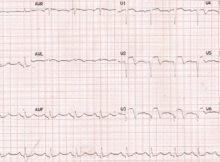
(Click on the image for an enlarged view) ECG sign visible on this ECG: a) Katz-Wachtel sign b) Pardee sign c) aVR sign d) Wellen’s sign Correct Answer You
60/60 sign has been described in: a) Acute myocardial infarction b) Acute aortic dissection c) Acute pulmonary embolism d) None of the above Correct Answer
Starr-Edwards prosthetic valve in mitral position can be differentiated from aortic position by: a) Cage of prosthesis pointing down and to the left b) Four struts for mitral
Aorta – left atrium M-mode Mode echocardiogram at aorta-left atrium level Mode tracing at the aorta-left atrium level is often the first M-mode tracing to be taken from the
Alcohol flushing syndrome has been associated with: a) Coronary vasospastic angina b) Dilated cardiomyopathy c) Metabolic syndrome d) Both a and c Correct Answer
Identify the cardiac chamber with filling defect marked by red arrow in the Cardiac CT: a) Right atrium b) Left atrium c) Right ventricle d) Left ventricle Correct