Atrial pacing ECG ECG showing atrial pacing artefact before each P wave Pacing artefacts (stimulus artefacts or pacing spikes) are seen before each P wave. P waves have
AF with slow ventricular rate Atrial fibrillation (AF) with slow ventricular rate Fine fibrillary waves are seen throughout the baseline, indicating fine atrial fibrillation. When the fibrillary waves
When do you consider epicardial mapping for ventricular tachycardia (VT)? Indications for epicardial mapping: Mapping and ablation of ventricular tachycardia (VT) is usually done from the endocardial approach
ECG showing isorhythmic AV dissociation Isorhythmic AV dissociation is one of the three forms of AV (atrioventricular) dissociations which can be noted on the ECG. Complete heart block
ST prolongation in hypocalcemia ST prolongation in hypocalcemia: ST prolongation as a cause of QT interval prolongation is less common than other mechanisms of QT prolongation. In most
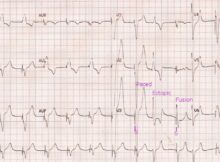
VVI pacing with ectopic beat and fusion beat VVI pacing with ectopic beat and fusion beat: Basic rhythm in this ECG is a paced rhythm, with pacing spikes
RBBB, LAHB, Junctional rhythm RBBB with LAHB & Junctional rhythm: ECG shows a slow regular rhythm with a ventricular rate of around 43/min. Though there are some baseline
Old inferior wall infarction and lateral ST depression ECG shows sinus rhythm at around 75/min, with pathological Q waves in inferior leads, indicating old inferior wall myocardial infarction.
Monomorphic ventricular premature complex (VPC) Basic rhythm in the ECG is sinus rhythm at around 60/min. There are two wide QRS complexes seen in lead II rhythm strip.