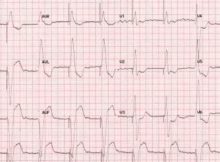
Tall peaked T waves in hyperkalemia is due to the enhanced outward potassium current IKr. QRS widening is due to the reduced Vmax as the intracellular negativity
Prolongation of action potential duration in hypokalemia is due to inhibition of the outward potassium current. IKr, the rapid component of the delayed rectifier potassium current, is markedly
ECG showing right ventricular apical pacing in VVI mode with very wide QRS due left ventricular myocardial damage and associated coarse atrial fibrillation.
Epicardial route will not be useful for ablation of:
a) Fascicular VT
b) Bundle branch re-entrant VT
c) VT originating from the papillary muscle
d) All of the above
Wrong about defibrillation:
a) If in water, move out
b) Can defibrillate if lying on snow or ice
c) Chest drenched with perspiration should be wiped before defibrillation patches are applied
d)
Re-ablation of left sided accessory pathways deferred 2 months because: a) Friable tissue b) Delayed loss of conduction c) Edema distorts local electrogram d) All of the above
Narrow P waves are seen in:
a) Sinus rhythm
b) Retrograde activation thro' lateral pathways
c) Retrograde activation thro' septal pathways
d) None of the above