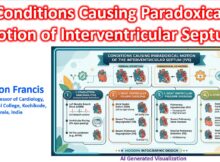
Paradoxical motion of the interventricular septum (IVS) occurs when the septum moves away from the left ventricular (LV) free wall during systole, disrupting the normal, coordinated inward contraction
In clinical medicine and physiology, the term “aldosterone escape” is notoriously confusing because it refers to two entirely distinct phenomena depending on the context. To clarify the pathophysiology,
A myocardial bridge is a congenital anomaly where a segment of an epicardial coronary artery—most commonly the mid-left anterior descending (LAD) artery—dips into the myocardium and runs under
Left atrial abnormality (LAA) is the most accurate and guideline-preferred terminology. The 2009 AHA/ACCF/HRS recommendations for the standardization and interpretation of the electrocardiogram explicitly favor “abnormality” over “enlargement,”
The cornerstone of managing hypertriglyceridemia is targeting hepatic very-low-density lipoprotein (VLDL) synthesis and upregulating lipoprotein lipase (LPL) clearance of triglyceride-rich lipoproteins. For patients with persistently elevated triglycerides (>150
Coronary angiography relies on fluoroscopy, which projects a complex, dynamic, three-dimensional anatomical structure onto a two-dimensional plane. Because of this dimensional loss, relying on a single view inevitably
Here is a step-by-step breakdown of a Percutaneous Coronary Intervention (PCI) or Coronary Angioplasty. It is used to remove major blocks in the coronary arteries, mostly for symptom
As per current major societal guidelines, ICD implantation is generally contraindicated (Class III) in clinical scenarios where the arrhythmic risk is transient, reversible, or curable, or when survival
Lead aVR has historically been dubbed the “forgotten lead” in electrocardiography. Because it looks at the heart from the right shoulder, all major depolarization vectors move away from
The presternal region is notoriously prone to aberrant scar remodeling following a median sternotomy. It is a common clinical trajectory for a wound to appear well-approximated and flat