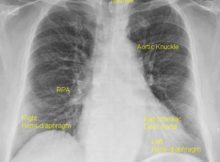
Mechanisms of improvement of heart failure in VSD Mechanisms of improvement of heart failure in VSD: If a child with ventricular septal defect (VSD) and heart failure improves,
Hypertension in Polycythemia Rubra Vera Multiple mechanisms have been proposed as the cause of systemic hypertension in polycythemia rubra vera: Increased number of circulating erythrocytes increase the blood
Ventricular Premature Complexes Ventricular Premature Complexes, also known as ventricular ectopic beats are recognized in the ECG as bizarre QRS complexes not preceded by a P wave and
Coconut atrium Coconut atrium is the term coined for complete calcification of the left atrium in chronic rheumatic valvular heart disease [1]. The stimulus for calcification could be
Sinus Bradycardia on ECG Sinus bradycardia on ECG is characterised by regular P waves preceding every QRS complex, at a rate below 60 per minute. P wave originating
QRS Complex QRS complex represents the depolarization of the ventricles. Initial negative deflection is named as the Q wave and a negative deflection after a positive deflection the
Segments and Intervals in an ECG Segments and Intervals in an ECG: A segment in an electrocardiogram is the region between two waves. PR segment begins at the