Which of the following is not used in provocative testing for Brugada syndrome? a) Ajmaline b) Isoprenaline c) Flecainide d) Procainamide Correct answer: b) Isoprenaline ST elevation in
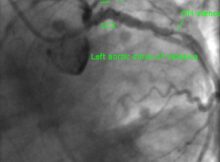
Proximal right coronary artery stenosis Right coronary artery stenosis: Right coronary angiogram in LAO (left anterior oblique) cranial view shows proximal luminal irregularities with narrowest segment near the
Spider view – LAO caudal view – coronary angiogram Spider view – LAO (left anterior oblique) caudal view [1] is often the first view taken during diagnostic coronary
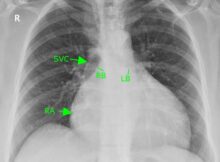
Prominent right atrial and superior vena caval shadow Chest X-ray PA view showing prominent right atrial and superior vena caval shadow along with mild cardiomegaly. Right atrial enlargement
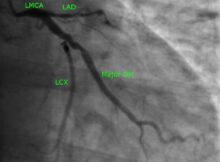
Stenosis of left circumflex and major obtuse marginal coronary arteries Coronary angiograms in RAO caudal and AP caudal views, showing stenosis of left circumflex and major obtuse marginal
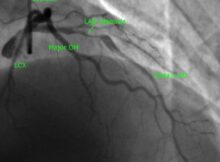
Left anterior descending coronary artery stenosis Stenosis of mid segment of left anterior descending (LAD) coronary artery seen on anteroposterior (AP) cranial view just after diagonal branch. Distal
Deep T inversion First few conditions which come to our mind when we see deep T wave inversions are: Coronary artery disease Hypertrophic cardiomyopathy Post cardiac arrest state
Inferolateral myocardial infarction ST segment elevation is seen in inferolateral leads (II, III, aVF, V5, V6) indicating inferolateral ST elevation myocardial infarction (STEMI). There is a discordance between
Right bundle branch block with right upper quadrant axis ECG demonstrating right bundle branch block with right upper quadrant axis: rsR’ pattern in V1, rS pattern in I,