Threshold for transfusion in anemia with acute coronary syndrome and no hemodynamic compromise: a) <10 g/dl b) <9 g/dl c) <8 g/dl d) <5 g/dl Correct answer c)
Wrong statement about prasugrel: a) Not influenced by CYP inhibitors b) Higher bleeding risk in those with previous cerebrovascular events c) Use in acute coronary syndrome is better
Limitations of clopidogrel Important limitations of clopidogrel, a commonly used antiplatelet agent are: Slow onset of antiplatelet effect Unpredictable maximal level of platelet inhibition Wide variability of pharmacodynamic response due to: Genotype polymorphisms
D shaped LV cavity in severe RVH Echo from parasternal short axis view shows a D shaped LV cavity (left ventricular cavity) alongside a grossly hypertrophied right ventricle
Pregnancy increases risk of aortic dissection There are several reports mentioning that pregnancy increases risk of aortic dissection, especially in those predisposed due to aortic disease. A study
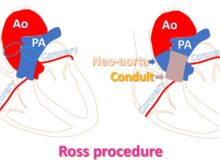
Ross procedure in adults Ross procedure (pulmonary autograft for aortic position) was used for aortic valve disease initially in children and later in adults. The pulmonary valve along
Signs in myocardial bridging: There are several named signs in myocardial bridging. Myocardial bridging is usually seen in left anterior descending coronary artery, with a segment of the
M-Mode echocardiogram at Aorta – Left atrium level M-Mode echocardiogram at Aorta – Left atrium level: M-Mode cuts are usually obtained from two dimensional (2-D) views after the proper
“Milking effect” phenomenon on coronary angiography has been described in: a) Critical left main stenosis b) Myocardial bridge c) Coronary aneurysm d) Coronary AV fistula Correct answer: b)